Carpiquet “The graveyard of the regiment.”[1]
By John Pezzola
Carpiquet “was more than an airfield; it was a vantage point from which the Allies could launch further advances into Normandy.”[2]
The fight for Carpiquet was a small engagement that occurred during a larger campaign as the Allies aimed to capture Caen, a key objective of Operation Overlord in 1944. By early July 1944, the intensity of the Normandy campaign was escalating, with Allied forces facing significant challenges in breaking through the German defenses established throughout the French countryside. Carpiquet Airfield, located west of Caen, held both tactical and symbolic importance. Controlling the area around the airfield was essential to establishing dominance over the Caen area, as it was considered a critical segment of the German defensive line. The Waffen-SS could observe British movements near Hill 112, which in turn dominated vital routes and observation points leading to the Odon Valley. The Canadians were tasked with capturing both Carpiquet Village and the airfield.[3]
Caen was initially supposed to be under Allied control on D-Day; however, stiff German resistance prevented this. The failure to secure Caen immediately allowed the Germans to fortify the surrounding positions, using the city as an anchor in their defensive line during the Normandy campaign. As a result, Carpiquet became a key objective in the days that followed.[4]
By late June, Canadian forces had already been engaged in a series of intense battles against German troops near Caen. Major General Rod Keller’s 3rd Canadian Infantry Division was tasked with conducting operations in the area. Keller had previously commanded Canadian forces at Juno Beach on D-Day and understood the operational challenges involved in capturing Carpiquet. The airfield at Carpiquet, originally used by the Luftwaffe, was heavily fortified and defended by the 12th SS Panzer Division Hitlerjugend. The 12th SS was a veteran unit, well prepared to mount a strong defense despite having suffered heavy losses in previous fighting. Their defensive positions included concrete pillboxes, machine gun nests, and mortar pits.[5]
The attack on Carpiquet would be carried out by the 8th Canadian Infantry Brigade, commanded by Brigadier General Kenneth Blackader. Blackader’s command was comprised of the following units: Royal Winnipeg Rifles, who were attached for the operation from the 7th Division; the North Shore Regiment (New Brunswick); the Queen’s Own Rifles of Canada; the Regiment de la Chaudière; the Regina Rifles Regiment; and the Cameron Highlanders of Ottawa Heavy Machine Gun Detachment. Also present were tanks from A and C Squadron of the Fort Garry Horse, as well as Flails, Crocodiles, and Petards from the 79th Armoured Division. Artillery support was provided by the 13th Royal Canadian Field Artillery Regiment, and air cover came from a squadron of Hawker Typhoons, in addition to naval support from the 16-inch guns of HMS Belfast and HMS Rodney that would provide a pre-bombardment of Carpiquet village on July 3, 1944.[6]
The Hitlerjugend took positions in and around Carpiquet and at the nearby airfield, allowing them time to prepare for defense. The I. Battalion of SS-Panzergrenadier-Regiment 26, commanded by Sturmbannführer Krause, was making defensive preparations. This battalion was relatively weak, having been reduced to approximately 300 men before the engagement on July 4. The remnants of Companies 2 and 4 were stationed in the old Luftwaffe bunkers and their surrounding defenses on the southern side of the airfield. In contrast, 1 Company was in the hangars to the north, while parts of 3 Company and one platoon from 1 Company were positioned in the village of Carpiquet. In total, there were 259 personnel, commanded by 35 non-commissioned officers (NCOs) and six officers.[7]
In terms of support, there were most likely two or three 7.5 cm Pak 40 anti-tank guns, along with a similar number of 8 cm mortars, and a 7.5 cm and a 15 cm Infanteriegeschütz infantry howitzer available for their defense from the III/12 SS Artillery Regiment, as well as elements of Wefer Regiment 83. In addition, there were around five Panzer IVs and Panthers that were dug in near the barracks.[8]
The Canadian Plan
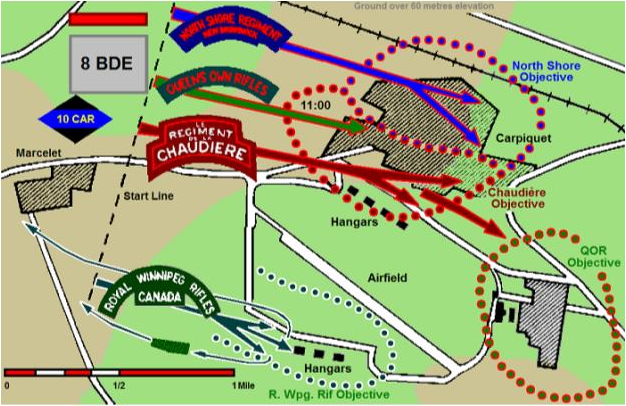
The Canadian Plan to assault Carpiquet was relatively straightforward. It called for a direct attack on the airfield and the nearby village. The Royal Winnipeg Regiment and “B” Squadron of the Fort Garry Horse would initiate the attack on the airfield, supported by artillery fire and armored units. At the same time, the North Shore (New Brunswick) Regiment, Queen’s Own Rifles, and the Regiment de la Chaudière, along with “A” and “C” Squadrons of the Fort Garry Horse, would launch their attack on the village and control buildings. The open terrain leading to the airfield provided limited cover for the advancing Canadian forces, while the Germans, well-fortified, had clear fields of fire.[9]
The Canadians needed to launch their assault under strong suppressive fire. The Royal Canadian 13th Field Artillery Regiment was responsible for delivering a devastating bombardment on the defenses of the Hitlerjugend formations before the Canadians moved from their starting line. The terrain between the village and the airport was relatively flat, with a single elevation about 80 meters above sea level located west of the village of Carpiquet. The Caen-Bayeux railway line ran northeast, providing some elevated ground. To the west of the village and south of the railway line were fields that extended up to the village and the airport. The airport contained several former Luftwaffe hangars at its northern and southern edges, dating back to 1940. Protecting the western approach to both the airfield and Carpiquet was a series of minefields.[10]
The headquarters of I Battalion, 26th Panzergrenadiers, was in a concrete bunker near the hangars to the south, with a view facing Marcelet. Strumbannführer was given intelligence indicating that an attack was imminent based on radio traffic signaling a high volume of Canadian communications. Bernhard Krause dispatched patrols, which confirmed that there was indeed significant activity. The patrol successfully relayed the positions of the Canadians, who soon fell victim to German artillery fire. The Radio Intelligence section managed to intercept Canadian radio traffic, confirming that indeed the German artillery fire was accurate. The Panzergrenadiers defending Carpiquet aimed to “tempt the enemy into the village and conduct a fighting withdrawal to the eastern edge where the 88mm guns were in ambush positions.”[11]
At 0500 hrs. The Canadian Infantry Battalions began their assault under the cover of a creeping barrage that was advancing toward known Hitlerjugend positions. Hitlerjugend responded in kind with its own artillery targeting the advancing Canadians, who were out in the open; however, the German artillery ran out of shells rather quickly in its attempt to thwart the Canadian advance. Hitlerjugend 3rd Infantry Company, positioned in the village, as well as a Zug (platoon) from the 1st Company, were crouching in their bunkers as they bore the brunt of the Canadian artillery barrage.[12]
According to Sturmmann Wambach
As the Canadians continued their advance, they faced attacks from 28cm/32cm Wurfkörper Spreng (explosive missile) rockets. However, they began to move more quickly as they received support not only from their tanks but also from artillery and naval gunfire that was called in. One of the problems that the Canadians had was the infantry and armored cooperation due to communications. The tanks carried the Type 38 radios, which were not compatible with the infantry Type 19 hand radio. This hampered the infantry and armored forces from working in concert at times.[15]
https://www.canadiansoldiers.com/history/battlehonours/northwesteurope/carpiquet.htm
Attacking from the south of the village were the Chaudière companies, which successfully captured the northern perimeter of the airfield. Following behind them were the tanks from the Fort Garry Horse Regiment. In addition to using their guns, the tanks also made effective use of their tracks in combat by collapsing many a German trench and foxhole. According to Major J. F. Anderson, who was one of the company commanders, he stated,
https://www.ww2incolor.com/gallery/canadian-forces/28995/canadians-at-carpiquet
At 1540 hours, according to the diarist of the Fort Gary Horse, they, as well as the Royal Winnipeg Rifles, had no choice but to withdraw from their current position about 800m to the west of the hangars. The Mark IV’s and Panthers prevented the Canadian armor from moving forward. One of the Panther commanders was awarded the Knight’s Cross for his gallantry during the engagement. The fighting around these positions was fierce and resulted in significant casualties, particularly among the Canadian armored units. They once again called for artillery support, which relentlessly targeted the German defenses, aiming to weaken their position and provide an opportunity for renewed assaults. SS Senior Sergeant Wohlgemuth, who commanded an anti-tank platoon from Krause’s 4th Company, goes on to describe the engagement that took place.[21]
The German Army had instructed Hitlerjugend to launch a counterattack, but the operation primarily fell to the 1st Panzergrenadier Regiment, which was assigned the majority of the III Battalion along with support from various companies. The II Battalion remained stationed in the barracks, allowing them to coordinate fire support in the village. Under the cover of darkness, the I and III battalions advanced across the open fields, carefully avoiding detection and aerial assaults, planning to execute an attack southward from the Caen-Bayeux Road. The attack was enacted prior to the arrival of dawn. A grenadier by the name of Riff of the 2nd Company stated, “The going was quiet as far as the railway embankment, where the level crossing keeper’s house stood. As soon as we crossed the embankment, however, all hell broke loose.’[24] As it was, the Canadians were waiting for a counterattack from the panzergrenadiers, who, regardless of heavy fire from the Canadians, continued to press forward towards their objective, that being the village. However, they were driven back by heavy tank and machine gun fire. Very few of the Panzergrenadiers ever reached their objective while at the same time falling victim to friendly artillery fire.[25] Immediately, the Panzergrenadiers try to take cover along the embankment of the railway line, only to be pinned down by incoming artillery fire. As night faded, German tanks, notably the Panthers, came into view.[26]
At the break of dawn, the Canadians deployed magnesium flares that illuminated the area, prompting the German armor to pull back towards Caen. Amidst the German withdrawal, 1st SS Liebstandarte was ready to counterattack. However, Kurt Meyer decided against it, considering the operation too risky and opting not to commit his reserves. The Canadians successfully created a salient in the German defenses, and the loss of the Arifeld and village was regarded as a significant blow to the Germans, threatening their overall defense around Caen and the bridges over the Orne River.[27]
Operation Windsor did not achieve complete success. According to Lieutenant General Miles Dempsey, Commander of the Second Army, it became clear that substantial resources would be necessary to capture Caen, and such an endeavor would inevitably incur very high casualties. Dempsey concluded that a successful operation to seize Caen would require leveraging the Royal Air Force Bomber Command for a large-scale bombing campaign.[28]
The cost of Operation Windsor was high in terms of casualties for both sides. The 3rd Canadian Division experienced significant losses: the North Shore Regiment suffered 132 casualties, including 46 killed, while the Chaudière Regiment had 57 casualties, with 16 fatalities. The Queens Regiment reported 22 wounded and 4 dead. Additionally, the Royal Winnipeg Rifles, part of the 7th Canadian Infantry Brigade, endured 132 casualties, which included 40 killed. The Canadians also saw a substantial number of tanks destroyed during the operation. On the German side, the Wehrmacht also faced heavy casualties, which were detrimental as they could not be easily replaced.[29]
APPENDIX A: The Churchill Crocodile Tank:
The Churchill Crocodile, produced in October 1943, was a British flame-throwing tank based on the Infantry Tank, MK IV (A22) Churchill Mark VII. Developed by Major-General Percy Hobart, it was designed as a specialized armoured combat vehicle. Early in the war, various experiments were undertaken to equip British vehicles with flamethrowers, leading to prototypes like the Cockatrice, Basilisk, and the Wasp, the latter being a flamethrower-equipped Universal Carrier.[30] The Churchill Oke, a flamethrower variant of the Churchill Mark II, was developed by an officer from the Royal Tank Regiment and tested during the Dieppe Raid. Concurrently, the Petroleum Warfare Department, along with the AEC and the Ministry of Supply, worked on flamethrower-equipped Valentine tanks[31]
However, the Department of Tank Design favored the Churchill for further development, as it was considered the successor to the Valentine as an infantry tank. To initiate the flame, the projector utilized a fine spray of petrol from the Crocodile's main fuel tank. This spray was ignited by a spark plug, which in turn ignited the main fuel jet. The operator had the ability to release either long or short bursts of flaming fuel onto the target. Additionally, the operator could first spray the target with fuel and then ignite it with a short, pre-lit burst. There was enough fuel for 80 individual one-second bursts or an equivalent duration of continuous fire. The trailer could be jettisoned if it was hit or when empty, allowing the tank greater freedom of movement. The trailers were equipped with towbars so they could be retrieved by unit transport after the operation.[32]
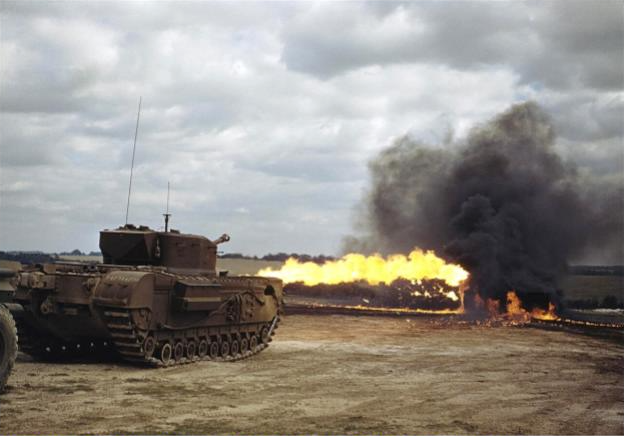
Flamethrowers in Action, August 1944 TR2313 - Churchill Crocodile - Wikipedia
Show Notes
© 2026 John Pezzola
John Pezzola is a veteran of the United States Army. I currently teach 7th-grade U.S. History and am an Assistant Professor of Military History at American Military University.
* Views expressed by contributors are their own and do not necessarily represent those of MilitaryHistoryOnline.com.
By John Pezzola
Carpiquet “was more than an airfield; it was a vantage point from which the Allies could launch further advances into Normandy.”[2]
The fight for Carpiquet was a small engagement that occurred during a larger campaign as the Allies aimed to capture Caen, a key objective of Operation Overlord in 1944. By early July 1944, the intensity of the Normandy campaign was escalating, with Allied forces facing significant challenges in breaking through the German defenses established throughout the French countryside. Carpiquet Airfield, located west of Caen, held both tactical and symbolic importance. Controlling the area around the airfield was essential to establishing dominance over the Caen area, as it was considered a critical segment of the German defensive line. The Waffen-SS could observe British movements near Hill 112, which in turn dominated vital routes and observation points leading to the Odon Valley. The Canadians were tasked with capturing both Carpiquet Village and the airfield.[3]
Caen was initially supposed to be under Allied control on D-Day; however, stiff German resistance prevented this. The failure to secure Caen immediately allowed the Germans to fortify the surrounding positions, using the city as an anchor in their defensive line during the Normandy campaign. As a result, Carpiquet became a key objective in the days that followed.[4]
By late June, Canadian forces had already been engaged in a series of intense battles against German troops near Caen. Major General Rod Keller’s 3rd Canadian Infantry Division was tasked with conducting operations in the area. Keller had previously commanded Canadian forces at Juno Beach on D-Day and understood the operational challenges involved in capturing Carpiquet. The airfield at Carpiquet, originally used by the Luftwaffe, was heavily fortified and defended by the 12th SS Panzer Division Hitlerjugend. The 12th SS was a veteran unit, well prepared to mount a strong defense despite having suffered heavy losses in previous fighting. Their defensive positions included concrete pillboxes, machine gun nests, and mortar pits.[5]
The attack on Carpiquet would be carried out by the 8th Canadian Infantry Brigade, commanded by Brigadier General Kenneth Blackader. Blackader’s command was comprised of the following units: Royal Winnipeg Rifles, who were attached for the operation from the 7th Division; the North Shore Regiment (New Brunswick); the Queen’s Own Rifles of Canada; the Regiment de la Chaudière; the Regina Rifles Regiment; and the Cameron Highlanders of Ottawa Heavy Machine Gun Detachment. Also present were tanks from A and C Squadron of the Fort Garry Horse, as well as Flails, Crocodiles, and Petards from the 79th Armoured Division. Artillery support was provided by the 13th Royal Canadian Field Artillery Regiment, and air cover came from a squadron of Hawker Typhoons, in addition to naval support from the 16-inch guns of HMS Belfast and HMS Rodney that would provide a pre-bombardment of Carpiquet village on July 3, 1944.[6]
The Hitlerjugend took positions in and around Carpiquet and at the nearby airfield, allowing them time to prepare for defense. The I. Battalion of SS-Panzergrenadier-Regiment 26, commanded by Sturmbannführer Krause, was making defensive preparations. This battalion was relatively weak, having been reduced to approximately 300 men before the engagement on July 4. The remnants of Companies 2 and 4 were stationed in the old Luftwaffe bunkers and their surrounding defenses on the southern side of the airfield. In contrast, 1 Company was in the hangars to the north, while parts of 3 Company and one platoon from 1 Company were positioned in the village of Carpiquet. In total, there were 259 personnel, commanded by 35 non-commissioned officers (NCOs) and six officers.[7]
In terms of support, there were most likely two or three 7.5 cm Pak 40 anti-tank guns, along with a similar number of 8 cm mortars, and a 7.5 cm and a 15 cm Infanteriegeschütz infantry howitzer available for their defense from the III/12 SS Artillery Regiment, as well as elements of Wefer Regiment 83. In addition, there were around five Panzer IVs and Panthers that were dug in near the barracks.[8]
The Canadian Plan
The Canadian Plan to assault Carpiquet was relatively straightforward. It called for a direct attack on the airfield and the nearby village. The Royal Winnipeg Regiment and “B” Squadron of the Fort Garry Horse would initiate the attack on the airfield, supported by artillery fire and armored units. At the same time, the North Shore (New Brunswick) Regiment, Queen’s Own Rifles, and the Regiment de la Chaudière, along with “A” and “C” Squadrons of the Fort Garry Horse, would launch their attack on the village and control buildings. The open terrain leading to the airfield provided limited cover for the advancing Canadian forces, while the Germans, well-fortified, had clear fields of fire.[9]
The Canadians needed to launch their assault under strong suppressive fire. The Royal Canadian 13th Field Artillery Regiment was responsible for delivering a devastating bombardment on the defenses of the Hitlerjugend formations before the Canadians moved from their starting line. The terrain between the village and the airport was relatively flat, with a single elevation about 80 meters above sea level located west of the village of Carpiquet. The Caen-Bayeux railway line ran northeast, providing some elevated ground. To the west of the village and south of the railway line were fields that extended up to the village and the airport. The airport contained several former Luftwaffe hangars at its northern and southern edges, dating back to 1940. Protecting the western approach to both the airfield and Carpiquet was a series of minefields.[10]
The headquarters of I Battalion, 26th Panzergrenadiers, was in a concrete bunker near the hangars to the south, with a view facing Marcelet. Strumbannführer was given intelligence indicating that an attack was imminent based on radio traffic signaling a high volume of Canadian communications. Bernhard Krause dispatched patrols, which confirmed that there was indeed significant activity. The patrol successfully relayed the positions of the Canadians, who soon fell victim to German artillery fire. The Radio Intelligence section managed to intercept Canadian radio traffic, confirming that indeed the German artillery fire was accurate. The Panzergrenadiers defending Carpiquet aimed to “tempt the enemy into the village and conduct a fighting withdrawal to the eastern edge where the 88mm guns were in ambush positions.”[11]
At 0500 hrs. The Canadian Infantry Battalions began their assault under the cover of a creeping barrage that was advancing toward known Hitlerjugend positions. Hitlerjugend responded in kind with its own artillery targeting the advancing Canadians, who were out in the open; however, the German artillery ran out of shells rather quickly in its attempt to thwart the Canadian advance. Hitlerjugend 3rd Infantry Company, positioned in the village, as well as a Zug (platoon) from the 1st Company, were crouching in their bunkers as they bore the brunt of the Canadian artillery barrage.[12]
According to Sturmmann Wambach
“as the enemy shellfire moved on, the leading tanks rolled toward us. I fired a green flare for our artillery, but I was seen by an enemy tank, which drove up and did a neutral turn over my trench in an attempt to crush me. I was partly buried and surrounded by enemy tanks, some of which were burning. Then the infantry came and shouted ‘Hands up, SS bastard.’ They pulled me out of the earth and tied me up and hit me in the face and body with their rifle butts. I was tied to a post in the open when German shells were landing and left there for hours before I was taken to the rear.”[13]Sturmman Wambach was responsible for firing flares to signal the artillery in case of a breakdown in communications. Meanwhile, the 3rd Kompanie, who were holding the hangars, was overwhelmed by the sheer numbers of the attacking force. As they fell back through the village, the fighting was slow and costly. The Hitlerjugend put up a strong fighting retreat, while the Canadians fought for every square inch of ground. The 79th Armoured Division joined the battle, demolishing buildings with their petard demolition rounds.[14]
As the Canadians continued their advance, they faced attacks from 28cm/32cm Wurfkörper Spreng (explosive missile) rockets. However, they began to move more quickly as they received support not only from their tanks but also from artillery and naval gunfire that was called in. One of the problems that the Canadians had was the infantry and armored cooperation due to communications. The tanks carried the Type 38 radios, which were not compatible with the infantry Type 19 hand radio. This hampered the infantry and armored forces from working in concert at times.[15]
https://www.canadiansoldiers.com/history/battlehonours/northwesteurope/carpiquet.htm
Attacking from the south of the village were the Chaudière companies, which successfully captured the northern perimeter of the airfield. Following behind them were the tanks from the Fort Garry Horse Regiment. In addition to using their guns, the tanks also made effective use of their tracks in combat by collapsing many a German trench and foxhole. According to Major J. F. Anderson, who was one of the company commanders, he stated,
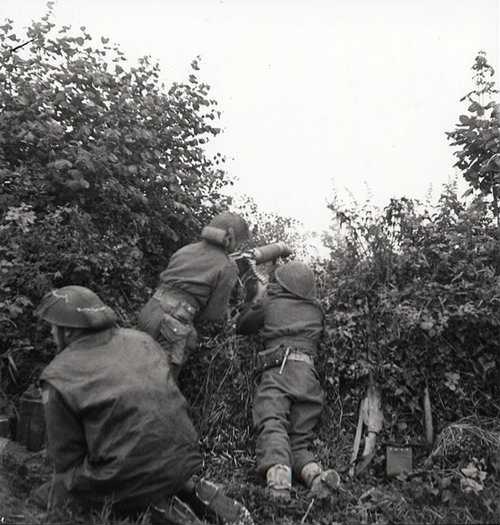
I am sure that at some time during the attack every man felt he could not go on. Men were being killed and wounded on all sides and the advance seemed pointless as well as hopeless. I never realized until the attack on Carpiquet how far discipline, pride of unit, and above all pride in oneself and family, can carry a man even when each step forward meant possible death.[16]As the third Battalion of the Royal Winnipeg Rifles enacted their attack against the hangars in the south, they came under intense German fire. The Royal Winnipeg Rifles were attacking across open ground towards the hangars. As the Royal Winnipeg Rifles approached the bunkers, they called upon the Crocodile flame tanks to aid in reducing the bunkers while the Royal Winnipeg Rifles assaulted the bunkers with grenades. grenades as well. By 1400 hours, the Canadians were reporting the capture of the village of Carpiquet, with only twenty panzergrenadiers having reportedly escaped.[17] According to Kurt Meyer, who commented on the withdrawal, the Grenadiers knew their business when he stated that
The company is to withdraw, fighting a delaying action, to the eastern edge of Carpiquet. . . . and tempt the attacking Canadians to enter the village. There are 88mm guns positioned in ambush just to the east of Carpiquet. Furthermore, the outskirts of the village lie within the field of fire of waiting tanks. . . . Our artillery and mortars are already zeroed in on the village.[18]As the Canadians approached the southern hangars, Sturmbannführer Krause had three Companies of Hitlerjugend at his disposal when he was attacked by a single Canadian battalion. Krauses Company was subjected to an intense barrage; however, they were able to hold out. According to Oberscharführer Erwin Wohlgemuth, he stated that he
Sheltered in one of the bunkers, but the shelling was so heavy that pieces of concrete were dropping off the roof. When it stopped, I went out to repel the enemy; two of our mortarmen were dead, and our artillery observation officer had a large shell splinter stuck in his back. The enemy attacked in groups, and we fired away, but only stopped them when they reached the first hangar.[19]As the Chaudière’s launched their attack against the center, they were experiencing light resistance for much of the German fire was placed upon the advancing North Shore Regiment. As for the Royal Winnipeg Rifles, who launched their assault against the south hangars, they were exposed to intense fire. According to a war diary of the Royal Winnipeg Rifles, 12th SS Hitlerjugend, the I Battalion of the 12th SS Panzer Regiment had a tactical advantage with a mix of dug-in Panzer IV and Panther tanks prepared for ambush positions. As Canadian tanks advanced towards the airfield, they faced immediate fire from these fortified German units, forcing them to fall back. Despite the heavy resistance, Canadian infantry pressed forward, enduring intense mortar and machine-gun fire, managing to close within 150 yards of the German trenches.[20]
https://www.ww2incolor.com/gallery/canadian-forces/28995/canadians-at-carpiquet
At 1540 hours, according to the diarist of the Fort Gary Horse, they, as well as the Royal Winnipeg Rifles, had no choice but to withdraw from their current position about 800m to the west of the hangars. The Mark IV’s and Panthers prevented the Canadian armor from moving forward. One of the Panther commanders was awarded the Knight’s Cross for his gallantry during the engagement. The fighting around these positions was fierce and resulted in significant casualties, particularly among the Canadian armored units. They once again called for artillery support, which relentlessly targeted the German defenses, aiming to weaken their position and provide an opportunity for renewed assaults. SS Senior Sergeant Wohlgemuth, who commanded an anti-tank platoon from Krause’s 4th Company, goes on to describe the engagement that took place.[21]
I was located in a former ammunition bunker. The explosions were of such violence that bits of concrete inside the bunker burst from its walls. Once the artillery fire had moved to the rear, I leaped ahead some 10m to the front squad of the mortar platoon, which had been killed. Also, our artillery observer was dead from a 25cm long fragment of a ship’s shell stuck in his back. There was no problem repelling the infantry attack. We concentrated our fire at the massed groups of infantry attacking. We concentrated our fire at the massed groups of attacking infantrymen until they retreated.[22]At around 1600 hours, the Canadians renewed their offensive operations targeting the southern hangars, this time advancing with flame-thrower Crocodile tanks. They quickly managed to breach the defenses of the I Battalion. Strumbannführer Krause ordered the remaining survivors of the Companies to retreat to headquarters to regroup. After regrouping, Krause organized a counterattack to support the remainder of the withdrawal. The Panthers from the 4th Company and the Panzer IVs from the 9th Company assisted in the extraction of Krause’s forces. By evening, the southern hangars and barracks were bombarded by approximately forty-four fighter-bombers, which targeted around seventeen Panzers located in and around the airfield. Faced with the overwhelming air assault, the Canadians chose to withdraw from their attack on the southern hangars and returned to their original line of departure.[23]
The German Army had instructed Hitlerjugend to launch a counterattack, but the operation primarily fell to the 1st Panzergrenadier Regiment, which was assigned the majority of the III Battalion along with support from various companies. The II Battalion remained stationed in the barracks, allowing them to coordinate fire support in the village. Under the cover of darkness, the I and III battalions advanced across the open fields, carefully avoiding detection and aerial assaults, planning to execute an attack southward from the Caen-Bayeux Road. The attack was enacted prior to the arrival of dawn. A grenadier by the name of Riff of the 2nd Company stated, “The going was quiet as far as the railway embankment, where the level crossing keeper’s house stood. As soon as we crossed the embankment, however, all hell broke loose.’[24] As it was, the Canadians were waiting for a counterattack from the panzergrenadiers, who, regardless of heavy fire from the Canadians, continued to press forward towards their objective, that being the village. However, they were driven back by heavy tank and machine gun fire. Very few of the Panzergrenadiers ever reached their objective while at the same time falling victim to friendly artillery fire.[25] Immediately, the Panzergrenadiers try to take cover along the embankment of the railway line, only to be pinned down by incoming artillery fire. As night faded, German tanks, notably the Panthers, came into view.[26]
At the break of dawn, the Canadians deployed magnesium flares that illuminated the area, prompting the German armor to pull back towards Caen. Amidst the German withdrawal, 1st SS Liebstandarte was ready to counterattack. However, Kurt Meyer decided against it, considering the operation too risky and opting not to commit his reserves. The Canadians successfully created a salient in the German defenses, and the loss of the Arifeld and village was regarded as a significant blow to the Germans, threatening their overall defense around Caen and the bridges over the Orne River.[27]
Operation Windsor did not achieve complete success. According to Lieutenant General Miles Dempsey, Commander of the Second Army, it became clear that substantial resources would be necessary to capture Caen, and such an endeavor would inevitably incur very high casualties. Dempsey concluded that a successful operation to seize Caen would require leveraging the Royal Air Force Bomber Command for a large-scale bombing campaign.[28]
The cost of Operation Windsor was high in terms of casualties for both sides. The 3rd Canadian Division experienced significant losses: the North Shore Regiment suffered 132 casualties, including 46 killed, while the Chaudière Regiment had 57 casualties, with 16 fatalities. The Queens Regiment reported 22 wounded and 4 dead. Additionally, the Royal Winnipeg Rifles, part of the 7th Canadian Infantry Brigade, endured 132 casualties, which included 40 killed. The Canadians also saw a substantial number of tanks destroyed during the operation. On the German side, the Wehrmacht also faced heavy casualties, which were detrimental as they could not be easily replaced.[29]
APPENDIX A: The Churchill Crocodile Tank:
The Churchill Crocodile, produced in October 1943, was a British flame-throwing tank based on the Infantry Tank, MK IV (A22) Churchill Mark VII. Developed by Major-General Percy Hobart, it was designed as a specialized armoured combat vehicle. Early in the war, various experiments were undertaken to equip British vehicles with flamethrowers, leading to prototypes like the Cockatrice, Basilisk, and the Wasp, the latter being a flamethrower-equipped Universal Carrier.[30] The Churchill Oke, a flamethrower variant of the Churchill Mark II, was developed by an officer from the Royal Tank Regiment and tested during the Dieppe Raid. Concurrently, the Petroleum Warfare Department, along with the AEC and the Ministry of Supply, worked on flamethrower-equipped Valentine tanks[31]
However, the Department of Tank Design favored the Churchill for further development, as it was considered the successor to the Valentine as an infantry tank. To initiate the flame, the projector utilized a fine spray of petrol from the Crocodile's main fuel tank. This spray was ignited by a spark plug, which in turn ignited the main fuel jet. The operator had the ability to release either long or short bursts of flaming fuel onto the target. Additionally, the operator could first spray the target with fuel and then ignite it with a short, pre-lit burst. There was enough fuel for 80 individual one-second bursts or an equivalent duration of continuous fire. The trailer could be jettisoned if it was hit or when empty, allowing the tank greater freedom of movement. The trailers were equipped with towbars so they could be retrieved by unit transport after the operation.[32]
Flamethrowers in Action, August 1944 TR2313 - Churchill Crocodile - Wikipedia
| * * * |
Show Notes
| * * * |
© 2026 John Pezzola
John Pezzola is a veteran of the United States Army. I currently teach 7th-grade U.S. History and am an Assistant Professor of Military History at American Military University.
* Views expressed by contributors are their own and do not necessarily represent those of MilitaryHistoryOnline.com.